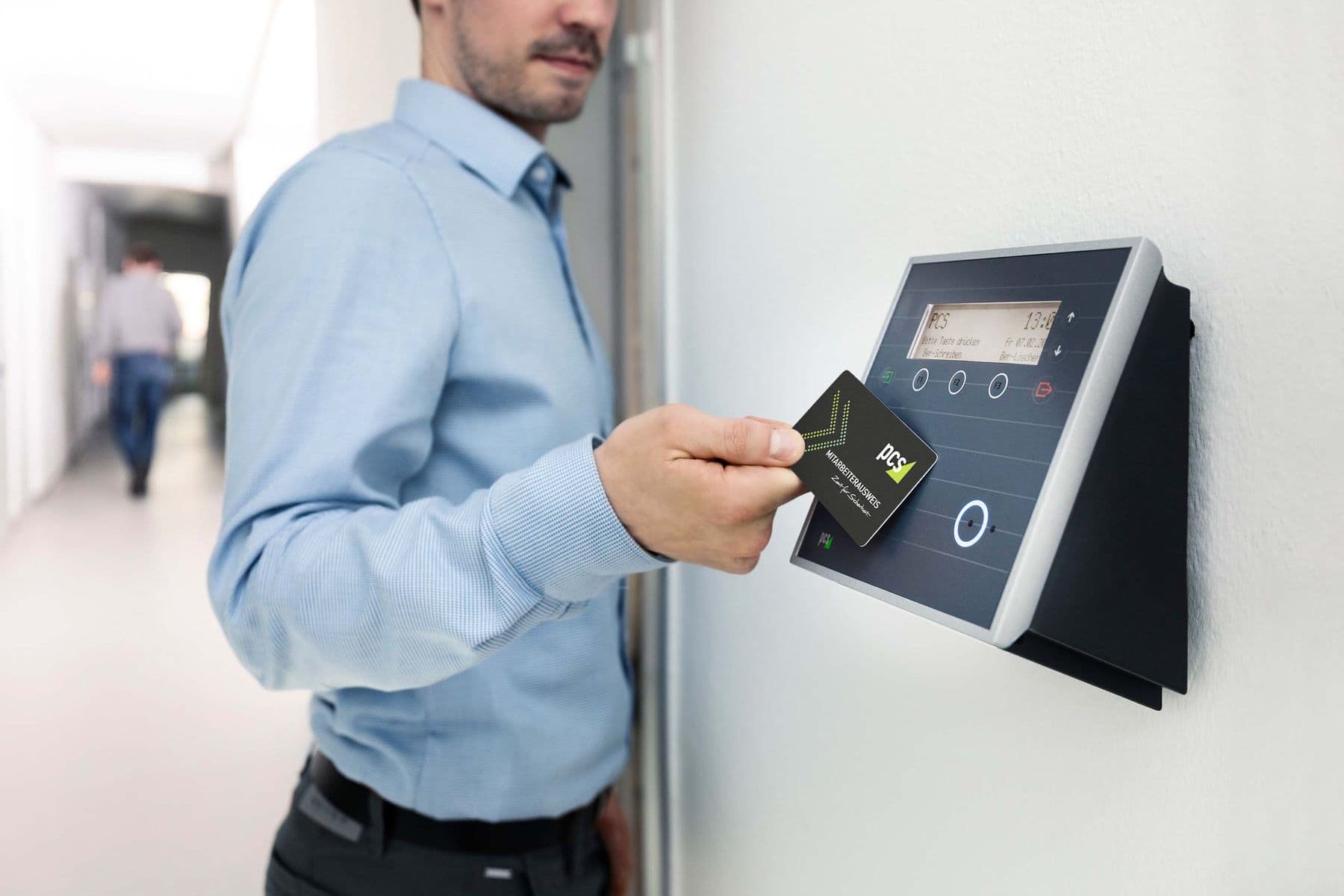
A card verifies the card, Face ID verifies the person. This post compares the two methods on operational criteria at a factory gate and shows how to use both on one system.
A factory gate is where workers, office staff, contractors and visitors pass every day, usually concentrated in a few windows at the start and end of each shift. The verification method at the gate decides throughput, the level of control and the guards' workload.
This post compares two common methods, access cards and face recognition, based on the specifications of the Face ID terminals used in Sol26 Access, and explains how to combine both in the same management software.
Cards: familiar, but dependent on who holds them
Short-range cards have long been used in factories, buildings and residential areas. The user taps the card on a reader, the system checks the card number and opens the door or barrier. The action is simple and users are used to it.
The weakness is that the system verifies the card, not the person holding it. Cards can be lent, tapped on someone else's behalf, lost or left at home. Each case produces an entry record for the wrong person or a manual check at the guard house.
- Issuing cards to new staff and collecting them from leavers
- Reissuing lost cards and blocking the old card number
- Visual checks when card sharing is suspected
- Managing temporary cards for visitors and contractors
Face recognition: verifying the right person
With Face ID the face is the credential, so it cannot be lent or used on someone else's behalf. The Face ID terminals used in Sol26 projects match in under 1 second, store up to 30,000 users and recognise users wearing masks.
The terminal has a dual RGB and infrared camera, a 10 inch display, a built-in QR code reader and an IP66 rating. Its software processes images in real time, distinguishes registered staff from strangers and triggers the door or barrier on successful verification.
Comparison on operational criteria
- Throughput: a card has to be taken out and tapped, Face ID only needs the user to stand in front of the terminal, with matching in under 1 second.
- Fraud: cards can be used by someone else, a face belongs to one person.
- Consumables: cards need printing, reissuing and collection, Face ID needs nothing issued per person.
- Leavers: cards must be collected, with Face ID the profile is simply deactivated in the software.
- Short-term visitors and contractors: temporary cards issued at the guard house and returned the same day.
Understanding FAR and FRR
The terminal specification lists a false acceptance rate (FAR) of 0.01% and a false rejection rate (FRR) of 4%. FAR is the probability that the system accepts someone against the wrong profile. FRR is the probability that the system rejects a registered person.
These figures show that face recognition still produces rejections that need a retry or verification at the guard house. Gate design should plan a procedure for these cases rather than assume every pass is automatic. The terminal software allows recognition settings to be tuned for each environment.
Combining face and card on one system
A business does not have to choose one or the other. The Sol26 gate access software controls short-range and long-range readers, RFID cards, Face ID terminals and automatic barriers, so each group of people can use the method that suits it.
The Face ID terminal has Wiegand input and output, RS485, RS232 and a relay for connecting peripheral equipment at the gate. Integrating devices from other brands requires the hardware supplier to provide API or SDK documentation.
- Permanent staff and workers: Face ID at pedestrian lanes
- Visitors: cards issued at the guard house
- Residents in residential areas: short-range cards
- Cars: plate recognition cameras or long-range UHF tags
Frequently asked questions
- Does Face ID recognise workers wearing masks?
- Yes. The Face ID terminals used in Sol26 Access support recognition while the user is wearing a mask.
- How many people can one Face ID terminal store?
- Up to 30,000 users according to the terminal specification. The list is managed in the central software and synchronised to each terminal.
- Can we keep our card system when moving to Face ID?
- The software integrates both card readers and Face ID terminals, so the two methods can run side by side. Reusing existing readers depends on whether the device supplier provides an API or SDK.
- What happens when Face ID wrongly rejects someone?
- The user tries again or is verified by the guard. The gate software includes manual handling for incidents.